Nuffnang

Monday, June 6, 2011

SPONSORSHIP NEEDED FOR PN ROBBIAH'S CATS


A good Samaritan who wishes to remain anonymus has called me and offered to take ALL of Pn Robbiah's cats. They will be well looked after, and will have lots of space to roam etc. Her only condition is that ALL of them MUST be spayed and neutered before she takes them. She has also offerred to sponsor the spaying and neutering of 10 of the cats, but has requested that I raise the funds for the rest.


Therefore I would like to appeal to all of you to please sponsor the neutering of at least 1 cat.

The cost of neutering is a MALE cat is RM75.00 including post-surgery care
at Setiawangsa Veterinary Clinic

The cost of spaying a FEMALE cat is RM120 including post-surgery care
at Shah Alam Veterinary Clinic.

This does not include amounts that may be incurred for treating cats that are sick, and THIS PRICE IS A ONE TIME DEAL only for Pn Robbiah's cats. These vets will not be taking in cats for any other cases.

I will post the amounts incurred at the vet, and if there is any access or leftover from any funds raised, this will go towards animal welfare work in general.


If you would like to sponsor the neutering of a cat, or any amount you can afford towards the neutering of a cat, please bank in the money to my account:

Please email me your name and the amount that you have sponsored to cleopatrathelabrador@gmail.com so that I can update my records accordingly.

In the mean time I would like to thank everyone for helping spread the word! It is very much appreciated!

Sincerely,
Natasha Fernz
Email: cleopatrathelabrador@gmail.com

********************
NOTE:

I would like to stress that any amount you donate should be PURELY VOLUNTARY.

********************
FRIDAY: 3 JUNE 2011

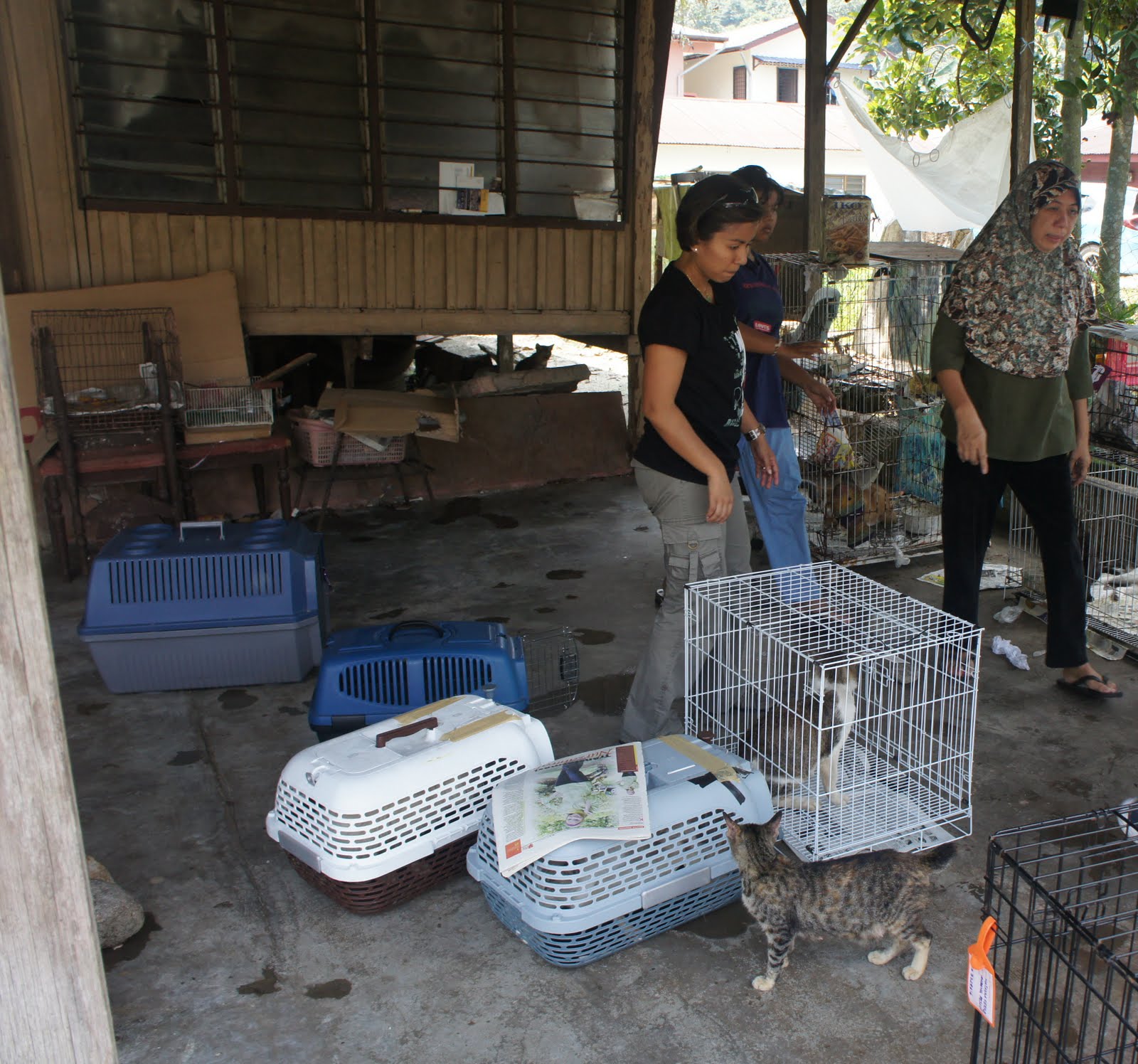
We have rescued a total of 37 cats!!! 20 adult cats, 3 kittens, 3 Mother Cats and their 11 Kittens!!! They will all be spayed/neutered before being sent to the adopter. Some of the cats are quite sickly, so they will be treated before they are spayed or neutered.

There are still a few more cats at Pn Robbiah's that we have not been able to catch today. If any of you have the resources to help out in catching them etc, please give Pn Robbiah a shout.

If you would like to contribute towards the medical costs, spaying and neutering costs, please bank in monies to me.

Any amount no matter how big or small will be greatly welcomed...Will post bills as and when I get them. Will also update the sponsorship box with all amounts donated.

I would like to say a big thank you to those who have already contributed, and more importantly to the 4 fabulous people who helped me out in today's operations. You know who you are! Thank you from the bottom of my heart!!!

Here are the pictures of the cats all safely at the clinics.I do apologise for the appalling description of the cats. I really do not know how to describe cats...


AT SETIAWANGSA VETERINARY CLINIC


Mother Cat with 2 Kittens
Male Cat with Amputated Tail
3 Male Cats
Black & White Male Cat
Mother Cat with 5 kittens
Male Cat
3 sick kittens
2 sick male cats
Mother Cat with 4 Kittens

*********************************************
AT SHAH ALAM VETERINARY CLINIC

Female Tabby with White Paws
Female Two Coloured Tabby
Tri-Coloured Female

5 Female Cats
4 Female Cats
*************************************************

THE RESCUE OPERATION


Thursday, June 2, 2011

URGENT: FOSTERERS OR ADOPTERS NEEDED FOR 30+ STRAY CATS

UPDATE: All cats have been rescued and re-homed
*****************************


Pn Robbiah is a 58 year old retiree that feeds and cares for over 30 stray cats in her area. Quite a number of these cats have actually been dumped at her home. With her limited means, she does the best that she can for these unwanted strays.

Many of them are sickly, and she takes them to the vet for treatment and looks after them as best as she can.

However, recently a neighbour filed a complaint to MPAJ. Pn Robbiah has been given till Sunday 5 June to remove all the cats from her premises and surrounding area or they will be confiscated.

Tuesday, May 31, 2011

MAN ON A MISSION

Extracted from: Gulf News
Man on a Mission

Al Ganem calls salukis God's gift to man. "They are intelligent and friendly," he says.

An old Arab proverb goes: 'He is a gentleman. He grew up with the saluki.' It seems to have been coined for Hamad Ganem Shaheen Al Ganem, director, breeder and registrar general of the Arabian Saluki Center; board member, Emirates Falconers' Club; and consultant to the Environment Agency, Abu Dhabi.

Arab Bedouins have been breeding salukis for thousands of years, Al Ganem tells me. These desert hounds, known for their exceptional stamina, intelligence and loyalty, are highly prized by the Bedouins. The Bedouins even allow them to share their tents. Al Ganem follows their example: his favourite salukis have a free run of the office. They are encouraged to sit on the sofas and spoken to as beloved family members.

Al Ganem possibly knows more about the Arabian tradition of breeding salukis than anyone in these parts. He comes from a well-known and respected Arab family famous in the region for breeding salukis. Al Ganem's family has been breeding the Aseel salukis the purest breed of Arabian hounds for about eight decades. The family tradition of saluki breeding has been passed on from fathers to sons for many generations, and to own one of the exceptional salukis bred by the family is said to be a privilege. "I am the fifth-generation breeder in my family," he says, "and the only one looking after our salukis."

With changing times and lifestyles, however, Al Ganem is finding it increasingly more important to see that the traditions of the land vested in hunting which include breeding and training salukis, Arabian horses and falconry is not lost. "The saluki may be lost to our future generations unless steps are taken to preserve it now," says Al Ganem. "That's why I want to write it all down, the history and the heritage [of the saluki and the falcon and their role in hunting]."

In fact, the one condition he insists on when we meet him is that we should be prepared to listen to him in full. No half measures with him. He sits on the sofa surrounded by his favourite symbols of Arabian heritage: salukis and falcons. There are three hooded falcons perched at various vantage points, one close enough to be stroked every now and then. Salaam, his favourite white saluki, is on hand to be petted and tossed a ball whenever he gets restless.

According to him, the history of the saluki is closely tied to the history of early man. "Salukis can be traced back to around 5000 BC. It all began with the domestication of the local wolf," he says. "This stemmed from man's necessity to catch game. It is said that the first domesticated dog, the saluki, evolved thus, by selective breeding."

Al Ganem tends to wax lyrical while talking about the Arabian desert, and its two famous breeds of animals the Arabian horse and the saluki hound. "The saluki was bred to assist man in catching prey in the harsh desert climate. Salukis ate what their masters ate, shared their tents and their food."

Later on, he takes us behind the office where a large pen houses a host of salukis waiting to be bred. He takes us into the kitchen where a qualified chef prepares food for the salukis: rice and meat, mildly flavoured and fit enough for man to eat. In fact, he tastes it and offers us some. It's like mildly spiced biryani.

"It is in fact based on the biryani," he says. "But not spicy, and very healthy. This is the kind of food we eat. In fact, the saluki used to eat from the same pot as the master in the past when possessions were few: first the master would eat, and then the saluki."

He declares, "We don't call our salukis 'dogs'. They are much more to us."

His love for the animals is evident in his every look. He's even devised a dessert for his salukis: a muffin made of wheat, honey and dates. We taste that too, and pronounce it fit for human consumption. According to Al Ganem, Bedouins still hunt with the salukis. The period from October to March is said to be ideal, and the Empty Quarter in the Arabian desert is their favourite hunting ground. "Young hounds are kept at home until about a year old to run with an older experienced saluki in the field," he says. "The youngsters pick up the idea fairly quickly and are trained to chase desert rats before moving onto other games such as rabbits, hares, foxes, gazelles, and so on."

Salukis are generally taken on hunts along with falcons. "The falcons spot and hover over their prey pointing out their position from the air, while the saluki dashes to the prey leading the hunters to it. The targets are often many kilometres away, but that is child's play for a saluki."

Where the saluki scores over the falcon, he says, is in its ability to hunt on the ground. "The saluki hunts the rabbit, and we send the falcon to get him. But when the rabbit goes into a bush or hole, the falcon can't catch him. Only the saluki can."

Little wonder then that Al Ganem calls salukis God's gift to man. "They are intelligent and friendly, though perhaps reserved with strangers," he says. "Though they are hunters by instinct, they are very calm and sweet-tempered, which also makes them great pets. They have a great sense of humour and are very curious." His dogs are a case in point. They take to us very easily, hovering around to be petted, but not so effusive as to put you off.

Al Ganem says salukis are so respected that even their names are chosen with special care. "They are a gift to us and we treat them as such by giving them titles," he says.

It's apparent he has researched extensively on salukis. "There is a saying that many Bedouins will not touch a dog, but they will touch a saluki. They believe salukis are the only breed of dog permitted to live in the home of a true believer."

His diligence in recording information about the saluki led him to collaborate in the production of a National Geographic documentary, 'Running with the wind', in 2002.

He's even written a children's book on the saluki, and welcomes students from schools in the UAE to the Arabian Saluki Center to give them an insight into Arabian heritage and tradition.

A consultant to the Emirates Falconers' Club, Al Ganem is also involved in the planning of the Desert Village and Hunting Park, a theme park that will showcase the Arab tradition of hunting with salukis, falcons, camels and horses. "It will include everything to do with our culture, including the Bedouins, and will be located outside Abu Dhabi city," he says. "We may even include pearl diving and dhows as part of our culture. We plan it as an education centre too, and will have heritage racing tracks that will hold displays of hunting, saluki racing. It will be spread over an area of four kilometres."

Al Ganem believes it is his calling to carry on the tradition of saluki breeding, and pass it on to his heirs. "When I met the late Shaikh Zayed Bin Sultan Al Nahyan he held my hand and told me: 'The saluki has different uses; not only hunting for you, but also feeding you and protecting you and your camels and sheep. They are an important part of our hospitality as they guide your guests to you.' It was then that it dawned on me that in the olden days people were lonely and used to welcome guests to their tents. Travellers came upon a saluki and knew there would be a house nearby, so they would follow them home. That to me is the ultimate story about the saluki."

Wednesday, March 30, 2011

PUPPIES FOR ADOPTION

These two puppies were dumped at a construction site recently. Please call Margy at this number 019-3443214 if you would like to adopt them.

DOGS FOR URGENT ADOTPION

Dear all,

The following dogs are up for urgent adoption. They are currently at risk of being put to sleep by MPPJ as their owner Sham Van Boonstra Nasution has 6 dogs in her care. MPPJ has basically given her an ultimatum to remove them from her property by the end of this week, 1 April 2011 or they will be seized and put to sleep.

Please call Sham at 017 368 8660 if you are willing to adopt or at least foster these dogs.


LUCKY.
Mixed Breed, Male, 2years old, Medium sized, Neutered & Vaccinated
Looks exactly like a Miniature German Shepher/Alsatian dog. He will be a great guard dog. Very friendly, loves cuddles but will bark at strangers.


AFRICA
Mixed Breed, Male, 3years old, Neutered & Vaccinated
Well behaved and a little shy. Loves to just sit quietly in a corner. Loves wagging his tail when happy!


LONDON.
Japanese Spitz Mixed, Female, 4 yrs old. Medium Sized, Vaccinated.
Very friendly and loves to be petted. Independent and will sit in one corner most of the time.


NEW YORK.
Mixed Breed, 4 yrs old, Medium sized but a little tall, Vaccinated
Very friendly and loves to be petted. Generally well behaved and is happy to sit quietly for the most part of the day. Good with kids.


Please help save these dogs from being put down...
Call Sham if you can help her at 017 368 8660

Tuesday, March 29, 2011

DOGS 101 - JACK RUSSELL


Here's a short video from Animal Planet's Dogs 101 about Jack Russell Terriers. As Scruffy is a JRT cross, we decided that it was important that potential adopters know what they are getting themselves into.

JACK RUSSELL TERRIER – information sheet
Source : The Jack Russell Terrier Club of America (JRTCA)

The Jack Russell is a happy, bold, energetic dog; they are extremely loyal, intelligent and assertive. Their greatest attribute is their working ability, closely followed by their excellent qualities as a companion. A Jack Russell can be equally contented bolting a fox or chasing a toy in your living room, or equally adept at killing a sock in the living room or a rat in your barn. Their funny antics will continually amuse you, their intelligence seems to know no bounds and their assertive nature and boundless energy can at times be overwhelming.

The unique personality of this feisty little terrier is capturing the hearts of many, but they are not a dog for everyone.

A Hunting Dog
While adaptable to a variety of environments, they are first and foremost bred to be hunting dogs. City or apartment living, or a confined or sedate lifestyle, do not meet the needs of a Jack Russell. These little dogs require what may seem to be an extraordinary amount of human attention, outdoor activity, exercise, discipline and an understanding and acceptance of their hunting nature. They have been known to train their owners more often than not.

Jack Russells can be very aggressive with other dogs, and in fact more than two should never be kept together unattended. There have been many instances of terriers being hurt, even killed, by their fellow terriers; even young pups over the age of eight weeks must be carefully monitored. It is imperative that prospective Jack Russell owners understand this part of the terrier's nature. Special facilities and handing are absolutely necessary when owning a Jack Russell, and especially when owning two or more Jack Russells. Their natural hunting instinct also brings out aggression towards other small animals such as cats, gerbils, guinea pigs, etc.

It is said that the courage of the Jack Russell is never in doubt; surely a true statement, as they have often been known to take on an adversary twice (or more) their size. They require firm, consistent, responsible handing; they are very intelligent, determined and bold (sometimes to the point of abandon, which could be fatal).

While outdoor activity and exercise is essential, the Jack Russell should never be permitted to roam unattended, even in the most remote country setting. The Jack Russell is, above all, a hunting dog - and will go to ground at every given opportunity, to any quarry - they are afraid of nothing. Many a Jack Russell has been known to stay in an active earth for days, even weeks, without food or water because of the strong instinct bred into them to stay with their quarry. It can be very frightening experience to lose your terrier and an impossible situation to the untrained owner inexperienced in earthwork; the results could be tragic.

A Family Pet
The Jack Russell can make a terrific family pet, and gets along well with well behaved children. One of the Jack Russell's most surprising qualities is a kind and gentle nature. He is usually friendly with small children, provided the child understands how to properly handle the terrier. Having the natural assertive terrier characteristics, however, the Jack Russell will not put up with even unintended abusive nature from a child. This should be carefully considered, particularly with children under the age of six.

The Jack Russell has been a popular breed in England for many years, and is now attracting a variety of followers with varied interests in this country and other countries around the world. AWAM strongly encourages all those interested in the breed to thoroughly study all aspects of the Jack Russell, its special characteristics and needs, and to make a careful evaluation of whether this unique little dog will fit into your lifestyle.

The Jack Russell does require special handling and you need to determine if the Jack Russell Terrier is the right dog for you.

The Jack Russell is a very special breed; it has been kept sound, functional, intelligent and relatively unchanged because of responsible people who have cared about its heritage.

JACK RUSSELL TERRIER – Bad Dog Talk

The points made in this Bad Dog Talk have evolved over the years, and represent the worst case scenario of owning a Jack Russell Terrier. Many experienced, as well as inexperienced, dog owners are overwhelmed by the demands of a Jack Russell Terrier, leading to the dogs being abandoned even before they reach adulthood!
Jack Russells ...

... are first and foremost hunting dogs. The traits and skills that make them excellent hunting dogs (i.e., digging, barking, aggressive nature, ability to follow scent) are often interpreted as bad habits that cause people to give them up.

... are bred to go underground, following scent to locate and bark at quarry until they are dug down to or the quarry bolts. If they do not have an outlet for their natural instincts, they will invent new and fun jobs for themselves, which frequently include guardian of the world and/or their possessions and family, chasing cars, hunting birds, bugs or leaves, or endlessly digging in the soil.

... are a big dog in a little body. They have the same need (or more!) for exercise as a much larger dog... and the mentality to match -- they think they are at least 150 pounds, and are fearless, often challenging other dogs three times their size.

... are often aggressive with other dogs. Same-sex aggression and aggression towards other breeds of dogs is well documented with this terrier. It is strongly recommended that no more than two Jack Russells (of opposite sex only) ever be permitted to stay together unattended.

... are NOT a non-shedding breed! All coat types shed! Smooth coats shed the most, dropping hair continuously year round. Rough coats maintain the guard and dead coat, requiring manual shedding a few times a year. The broken coat is an intermediary coat, between the two types.

... require firm, consistent discipline. They are extremely intelligent, continue to test their limits throughout their life. More often than not, train their owners before the owner knows what has happened! This ability to train their owners can include displays of aggressive behavior. Their assertive nature must be understood and handled properly!

... can become very possessive of their owner or a favorite member of the family or of what they consider to be their personal property if allowed to do so to the point of showing aggressive protective behavior that must be controlled from an early age.

... are commonly known to harass, injure or kill other small pets, such as cats, birds, rabbits, mice, rats, etc., simply due to their strong natural hunting instinct. Raising a puppy with a cat does not guarantee the cat's life-long safety!

... remain active well into their 15-year-plus life span; their need for activity and desire to hunt continues for their entire lifetime. Untrained, unsupervised dogs rarely meet their life expectancy.

... require at least basic obedience training. The dog's life may depend on it! Even well trained dogs will be tempted to chase something interesting, or even disappear into a hole while you are not looking. Off-lead is always a dangerous situation for a Jack Russell unless in a safe environment with experienced JR owners.

... absolutely need a securely fenced yard! Jack Russells will roam due to their hunting instincts.... even if left in an unsecured for a few minutes! You can let them out every day for three years with no trouble....but one day they will disappear and may never come back. Many JR's have been killed by cars by darting into the road in pursuit of a squirrel, cat, etc. They can also dig under, climb or jump over fences; some can climb trees and any height chain link fencing.

... can be very destructive if left unattended and unemployed! Most behavioral problems are due to a lack of companionship, discipline, activity and exercise. If you've only seen perfect, well-behaved JR's, they are ones that were lucky enough to be exercised, well socialized, and trained.

... are country dogs. When made to live in a city or suburban-type environment, their needs and instincts do not change. It would be unreasonable to expect them to be anything other than what they are genetically bred to be -- a serious hunting dog. Your lifestyle must be adjusted to meet their needs; they must have jobs to perform -- an outlet for their considerable energy and intelligence.

... are NOT recommended as apartment or condo dogs. They need a great deal of exercise and outdoor activity, and are usually too loud for such high-density living. They need room to run; leash walking does not satisfy their boundless energy. Unless your schedule permits many hours at home and a lot of outdoor activity, with a safe place the terrier can run, this is not the dog for you. MANY rescues come from apartments, condos, or homes where the owners work away from the home for long periods of time.

... will NOT TOLERATE even unintended mistreatment from a child. They will not put up with typical child handling such as pulling of ears, tails, etc., or taking or "sharing" of the dog's bones, food, toys, etc. They are very assertive and demanding, and never still... jumping all over whoever will allow it. Jack Russells are not recommended for households with children under the age of six unless you are previously experienced with this feisty little bundle of energy.

... are NOT as they are portrayed in the movies, on TV, or other forms of media. Those dogs are professionally trained and handled, and are very obedient only for VERY short periods of time. Celebrity dogs have their needs met by the trainer, and perform their jobs accordingly.

... require a long-term commitment to obedience, activity, exercise and entertainment... their unique character, intelligence and high energy level can frustrate you, will undoubtedly entertain you, and can bring you great joy (when they're happy!) or great grief (when they're not!). If this type of relationship does not appeal to you, then consider another breed. Jack Russell Terriers are always a work in progress!

Sunday, March 27, 2011

Scruffy - Basic Clicker Training

SCRUFFY HAS BEEN ADOPTED
******************
Here's a short video of Scruffy doing the Sit & Down. Scruffy is currently being clicker trained and she is a fast learner.


This is a second video of Scruffy doing the Fetch, Heel, Sit & Down - all via the clicker


If you would like to adopt Scruffy, please call Natasha at 016 3228816.

Here's an additional video of Scruffy playing with our cat. As you can see her temperament is very good and she shows no aggression towards the cat.

Wednesday, March 23, 2011

Scruffy is still looking for a home

SCRUFFY HAS BEEN ADOPTED
******************

Scruffy Update:

19/3/2011 - Scruffy has been given the all clear from the vet regarding her mange. We are just monitoring her condition now to make sure it doesn't come back. She has also received her first vaccination shot!

If you can give Scruffy a loving and stable home, please call Natasha at 016 322 8816


Breed:Possibly Jack Russell Terrier Mix
Gender:Female
Age:3 Months
Color:Black, Brown, White
Size at Maturity:Medium
Hair Length:Medium
Vaccinated:Yes
Dewormed:Yes
Spayed/Neutered:No - will be spayed once she has completed her third vaccination
Health Condition:Healthy
Location:Ampang, Selangor
Adoption Fee:Free


For Scruffy's story, please click on the following link
http://animalwelfaremalaysia.blogspot.com/2011/02/scruffy-needs-home.html

Monday, February 28, 2011

SCRUFFY NEEDS A HOME

SCRUFFY HAS BEEN ADOPTED
******************


Hello, my name is Scruffy.
I am about 2 or 3 months old now and am looking for a forever home.

I used to live in the Hulu Kelang market. I was very sick and suffering from a severe case of sarcoptic mange. Because of that people didn't like me and used to kick me to get me away from them.

I could not understand why they couldn't see that all I wanted was for someone to love me, epsecially since my mommy died from eating some poisoned food...

Thankfully I was rescued from the market and my condition has improved significantly. My skin no longer smells bad, and all the nasty crusty stuff has gone away. My fur is starting to grow again too...

My carers think that I should be able to go to my new home soon.


As you can see I am a playful and energetic puppy but I am also a quick learner. I will do anything to please my new "parents".

I have already started potty training and I am proud to say that I can now hold my bladder for over 2 hours. My carers are very pleased with my progress, as I have already learnt not to "poo" in my crate. I have had ZERO poo acidents after my first day of potty training! :)


I will need lots of exercise, and hope to be able to go for daily walks. I will also need some obedience training, but I will need someone who will teach me with kindness and patience. I would like someone who will also spend time with me, and not leave me all alone for long periods.


I will be a faithful, loyal and loving companion,


Please call my carer, Natasha, at 016-322 8816
if you think you can find it in your heart to give me a home and family that I can call my own soon.

Sunday, February 20, 2011

What is Mange? And how to treat it....

Mange
Source: ASPCA

What Is Mange?

Mange is a skin disease caused by several species of tiny mites, common external parasites found in companion canines. Some mange mites are normal residents of your dog’s skin and hair follicles, while others are not. All mites can cause mild to severe skin infections if they proliferate.

What Causes Mange in Dogs?

Sarcoptic mange (Sarcoptes scabei) is transferred easily between hosts. Also known as canine scabies, sarcoptic mange is caused by mites that are oval-shaped, light-colored and microscopic.

All dogs raised normally by their mothers possess demodectic mange mites (Demodex canis), which are transferred from mother to pup via cuddling during the first few days of life. Most dogs live in harmony with their mites, never suffering any consequences.

There are three types of demodectic mange that affect canines. Localized cases occur when these mites proliferate in one or two small, confined areas. This results in isolated scaly bald patches—usually on the dog's face—creating a polka-dot appearance. Localized demodicosis is considered a common ailment of puppyhood, and approximately 90% of cases resolve with no treatment of any kind.

Generalized demodectic mange, in contrast, affects larger areas of skin or a dog’s entire body. Secondary bacterial infections make this a very itchy and often smelly skin disease. This form of mange could also be a sign of a compromised immune system, hereditary problem, endocrine problem or other underlying health issue. Treatment depends on the age at which the dog developed the disease.

One of the most resistant forms of mange, demodectic pododermatitis is confined to the foot and accompanied by bacterial infections. Deep biopsies are often required to locate these mites and make a proper diagnosis.


Is Demodectic Mange Contagious?

Current thinking is that Demodex mites can be transferred from one dog to another—but as long as the dog is healthy, the mites simply add to the dog's natural mite population and no skin disease results. Isolation of dogs with even the most severe cases is still felt to be unnecessary—though in rare circumstances, contagion is possible. While there are still different theories about dog-to-dog transmission of Demodex mites, it is accepted that mites cannot be transmitted to humans or to cats.

What Are the General Symptoms of Mange in Dogs?

The symptoms of mange depend on which type of mite is present. Demodectic mange tends to cause hair loss, bald spots, scabbing and sores. Secondary bacterial infections can make demodectic mange an itchy and uncomfortable disease.

Sarcoptic mange tends to cause intense itching. It can result in restlessness and frantic scratching, symptoms that generally appear one week after exposure. It also can result in hair loss, reddened skin, body sores and scabs. The most commonly affected areas are a dog’s ears, elbows, face and legs, but it can rapidly spread to the entire body.

When passed to humans, sarcoptic mange causes a rash of red bumps, similar to mosquito bites. Humans cannot get demodectic mange from dogs.

What Should I Do If I Think My Dog Has Mange?

Take your dog to a veterinarian, who will perform a physical exam, analyze skin scrapings and try to confirm the presence of mange mites with a microscope. It can be difficult to identify mange mites if they’re buried deep in a dog’s skin, so your vet may rely on clinical signs or your pet’s history to make a final diagnosis.

Are Certain Dogs Prone to Mange?

  • Puppies and dogs less than 18 months old are especially prone to developing localized demodectic mange, which often clears up on its own.
  • Generalized demodectic mange, the more serious, pervasive kind, can be hereditary in dogs. Old English sheepdogs and shar peis are prone to a severe form of demodectic mange affecting the feet. Older dogs who have an underlying illness may also be more prone.

How Is Mange Treated?

Depending on the type of mange and the breed of your dog, medication may be given orally or applied topically, by injection, or via shampoo and dip.

The first step in the treatment of sarcoptic mange is isolating your dog to prevent the condition from spreading to other pets and humans. Your vet may prescribe antiparasitic medications, as well as medication to ease itching, inflammation and secondary skin infections. Results are usually seen after a month of treatment.

Medications and managing physiological stress are essential when treating demodectic mange. Some infected dogs may also require special treatment—such as medicated shampoos—for secondary skin infections.

Please note, many skin treatments can be toxic to dogs and should not be repeated frequently, so check with your vet before beginning any treatment program for mange.

Is There a Cure for Mange?

Younger dogs often recover fully from mange, but adult dogs often require long-term therapy to control the disease. Dogs with demodectic mange should not be bred, as this condition is thought to be hereditary.

Treatment, no matter which option is chosen, should be accompanied by skin scrapes every two weeks. After two consecutive scrapes are negative, medication is discontinued, but a final scrape should be performed one month after treatment to ensure there isn’t a recurrence.

How Can I Prevent a Recurrence of Mange?

  • If your dog has been diagnosed with sarcoptic mange, you’ll need to thoroughly clean or replace his bedding and collar and treat all animals in contact.
  • If you suspect a neighbor’s dog may be infected, keep your pets away to keep the disease at bay.
  • Bring your dog to the vet periodically as recommended for recheck skin scrapes to ensure the mites have been eradicated.